The Issue of Ethics Was Raised Again in 1963 When
Chapter 4: Central Ethical Issues within Law Enforcement
four.three The Milgram Experiment
To demonstrate the ease with which power tin be used to coerce people, Stanley Milgram conducted a scientific experiment that demonstrated how far people will go when confronted with someone who has power and is in a position of say-so. In this instance, subjects often performed deportment that were unethical when ordered to by a person in authority. Milgram's experiment demonstrated the power of authority and how someone in a position of authorization tin influence people to bear unethically and against their wishes.
Milgram's Studies on Obedience to Authority
The powerful ability of those in authority to command others was demonstrated in a remarkable set of studies performed by Stanley Milgram (1963). Milgram was interested in understanding the factors that lead people to obey the orders given by people in say-so. He designed a written report in which he could observe the extent to which a person who presented himself as an authorization would be able to produce obedience, even to the extent of leading people to crusade impairment to others.
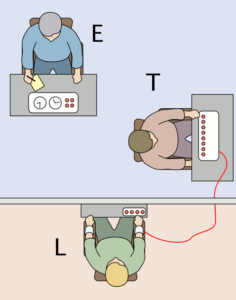
Like his professor Solomon Asch, Milgram'south involvement in social influence stemmed in role from his desire to sympathize how the presence of a powerful person—specially the German dictator Adolf Hitler who ordered the killing of millions of people during World War Two—could produce obedience. Under Hitler'south direction, the High german SS troops oversaw the execution of six million Jews too as other "undesirables," including political and religious dissidents, homosexuals, mentally and physically disabled people, and prisoners of war. Milgram used newspaper ads to recruit men (and in i study, women) from a wide multifariousness of backgrounds to participate in his research. When the enquiry participant arrived at the lab, he or she was introduced to a human who the participant believed was another inquiry participant just who was really an experimental confederate. The experimenter explained that the goal of the research was to study the effects of punishment on learning. Later the participant and the confederate both consented to participate in the written report, the researcher explained that one of them would exist randomly assigned to be the teacher and the other the learner. They were each given a slip of paper and asked to open it and to indicate what it said. In fact both papers read teacher, which immune the amalgamated to pretend that he had been assigned to be the learner and thus to assure that the actual participant was always the instructor. While the enquiry participant (now the teacher) looked on, the learner was taken into the adjoining daze room and strapped to an electrode that was to deliver the punishment. The experimenter explained that the teacher'southward job would exist to sit in the control room and to read a list of discussion pairs to the learner. After the teacher read the list once, it would exist the learner's task to think which words went together. For instance, if the discussion pair was blue-sofa, the teacher would say the discussion blue on the testing trials and the learner would accept to indicate which of four possible words (business firm, sofa, cat, or rug) was the right reply by pressing one of four buttons in forepart of him. After the experimenter gave the "teacher" a sample daze (which was said to exist at 45 volts) to demonstrate that the shocks really were painful, the experiment began. The enquiry participant first read the list of words to the learner and and so began testing him on his learning.
The shock console, as shown in [the figure],"The Daze Apparatus Used in Milgram's Obedience Written report," was presented in front of the teacher, and the learner was not visible in the daze room. The experimenter sat behind the teacher and explained to him that each time the learner made a mistake the teacher was to press i of the shock switches to administrate the daze. They were to begin with the smallest possible shock (15 volts) but with each mistake the stupor was increased by one level (an additional xv volts).
Once the learner (who was, of course, really an experimental confederate) was alone in the shock room, he unstrapped himself from the shock machine and brought out a record recorder that he used to play a prerecorded series of responses that the instructor could hear through the wall of the room. As you tin encounter in [the figure], "The Amalgamated'south Schedule of Protestation in the Milgram Experiments," the teacher heard the learner say "ugh!" after the first few shocks. After the adjacent few mistakes, when the shock level reached 150 volts, the learner was heard to exclaim "Get me out of here, please. My heart's starting to bother me. I refuse to go on. Let me out!" Equally the stupor reached about 270 volts, the learner's protests became more fierce, and afterward 300 volts the learner proclaimed that he was not going to reply any more questions. From 330 volts and up the learner was silent. The experimenter responded to participants' questions at this signal, if they asked any, with a scripted response indicating that they should keep reading the questions and applying increasing daze when the learner did non respond.
| 75 volts | Ugh! |
| 90 volts | Ugh! |
| 105 volts | Ugh! (louder) |
| 120 volts | Ugh! Hey, this really hurts. |
| 135 volts | Ugh!! |
| 150 volts | Ugh!! Experimenter! That'southward all. Get me out of hither. I told you lot I had centre trouble. My heart'due south starting to bother me now. Go me out of here, please. My centre's starting to bother me. I refuse to proceed. Let me out! |
| 165 volts | Ugh! Permit me out! (shouting) |
| 180 volts | Ugh! I tin't stand up the hurting. Let me out of hither! (shouting) |
| 195 volts | Ugh! Allow me out of here! Let me out of hither! My heart's bothering me. Permit me out of here! You accept no right to go on me here! Let me out! Permit me out of hither! Permit me out! Allow me out of hither! My heart'due south bothering me. Let me out! Let me out! |
| 210 volts | Ugh!! Experimenter! Go me out of hither. I've had enough. I won't exist in the experiment whatsoever more than. |
| 225 volts | Ugh! |
| 240 volts | Ugh! |
| 255 volts | Ugh! Get me out of here. |
| 270 volts | (agonized scream) Let me out of hither. Let me out of here. Let me out of here. Allow me out. Do you hear? Permit me out of hither. |
| 285 volts | (aching scream) |
| 300 volts | (agonized scream) I absolutely refuse to answer whatsoever more than. Become me out of here. You tin can't hold me here. Become me out. Become me out of here. |
| 315 volts | (intensely agonized scream) Let me out of here. Permit me out of hither. My heart's bothering me. Let me out, I tell you. (hysterically) Let me out of here. Let me out of hither. You have no correct to hold me here. Let me out! Let me out! Let me out! Let me out of here! Let me out! Permit me out! |
Earlier Milgram conducted his written report, he described the procedure to three groups—college students, centre-class adults, and psychiatrists—asking each of them if they thought they would stupor a participant who made sufficient errors at the highest end of the calibration (450 volts). One hundred pct of all three groups idea they would not do and so. He then asked them what per centum of "other people" would be likely to use the highest cease of the shock scale, at which signal the three groups demonstrated remarkable consistency by all producing (rather optimistic) estimates of around 1% to 2%.
The results of the bodily experiments were themselves quite shocking. Although all of the participants gave the initial mild levels of shock, responses varied subsequently that. Some refused to continue after about 150 volts, despite the insistence of the experimenter to proceed to increment the shock level. Yet others, even so, continued to present the questions, and to administrate the shocks, under the force per unit area of the experimenter, who demanded that they proceed. In the stop, 65% of the participants connected giving the shock to the learner all the way upwardly to the 450 volts maximum, even though that stupor was marked every bit "danger: astringent shock," and there had been no response heard from the participant for several trials. In sum, near two-thirds of the men who participated had, as far equally they knew, shocked another person to death, all as part of a supposed experiment on learning.
Milgram's study is important in a law enforcement context for the following reasons:
- Officers must exist careful in exercising authorisation, especially to those that are virtually vulnerable.
- Officers tin likewise be profoundly influenced by the negative/unethical deportment of fellow officers and their own supervisors. It is important for senior officers to sympathize that Milgram's written report strongly suggests that the actions of senior officers volition coerce the same activity in junior officers. While senior officers may think they are not being copied, or are manipulating the junior officer, Milgram'due south report suggests that they may be doing so.
- Police force enforcement officers are normally involved in boggling situations, where heightened stress and perceived danger are high. In this environment, even those virtually strong-willed individuals may be vulnerable to coercion.
- When a person is being arrested, his or her perception of losing freedom may provoke a reaction to the officeholder, despite the officer's position of power.
It is important for whatever person who possesses ability to understand and exist aware of the coercive nature of ability; that ability and authority are hands used to make people do things they otherwise would not do. It is inside this paradigm, that corruption of power tin occur, and officers must be aware of their ability and the ease with which it can be abused.
Text Attribution
The following clarification of Milgram's experiment comes from the chapter "Obedience, Power, and Leadership" from the open textbook volume Principles of Social Psychology: 1st International Edition. and is licensed CC BY four.0. All references cited on this folio can be constitute at the end of the chapter of Obedience Power and Leadership.
Source: https://opentextbc.ca/ethicsinlawenforcement/chapter/the-milgram-experiment/
0 Response to "The Issue of Ethics Was Raised Again in 1963 When"
Post a Comment