Art Piece Child Climbing Woman With Skeleton Behind Her
Fine art almost maternity has been devalued just almost equally long as the work of raising children has, and too many artists who become that route are quickly labeled eccentric. Simply starting in the 20th century, nosotros can notice many examples of artworks that utilise the images or materials of motherhood to great issue. Here are my picks for the x most powerful motherhood-related works from that fourth dimension. A few pieces have a quiet strength. Others are perhaps understandably more aggressive, demanding attention and insisting that what seems eccentric to others is actually a fundamental source of activity and inventiveness.
Käthe Kollwitz: Frau mit Totem Kind (Woman with Dead Child), 1903
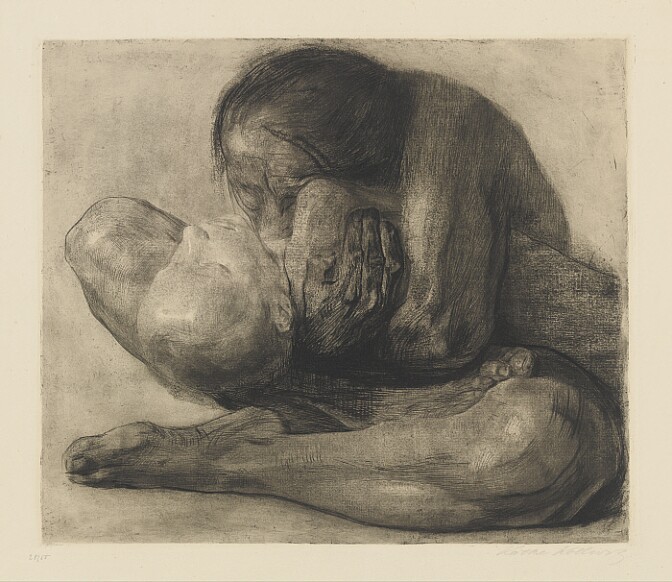
A High german artist who feels urgent today considering of her involvement in social issues like the physical and emotional cost of poverty, Kollwitz in 1903 made drawings and etchings of a woman cradling her dead child. We don't know the weather of his decease, but we are shown the style that event has simply cratered another life. The child'south face up is pale, calm, symmetrical, or in aesthetic terms classical. The female parent is the reverse, rendered in dark, scratchy, expressionistic lines — her eyes almost similar gouges — giving the impression her peel itself is torn past grief. The picture is also haunted past a wrenching irony: Kollwitz used her vii-year-old son Peter to model for the child. Xi years later, Peter was killed in Globe War I, prompting more than expressions of grief from Kollwitz.
Louise Bourgeois's Femme Maison (Wife House), 1947

Bourgeois's late-in-life, larger-than-life statuary and steel sculptures of spiders are widely historic for their night exploration of family dynamics, with the "maman" given spindly, spiky legs that make her an ambivalent figure, to say the least. Simply I have always had a soft spot for Bourgeois's unflinching "femme maison" paintings from nearly half a century before. I peculiarly like the full-length cartoon done in 1947 of a nude woman, but in place of her torso and head stands a house with many floors and numerous tiny windows. The house has literally taken over her brain. The French-born, American-based Bourgeois gave it the championship "femme maison." It'southward commonly translated as "woman house" simply also means "wife house," a play on the English structure "housewife," which posits, like this cartoon, a woman who fundamentally supports her house, is entirely divers past her house and might also exist married to her house.
More than Almost Art and Motherhood
Leonora Carrington's The Giantess (also known as The Guardian of the Egg), circa 1947

Of all earth mother imagery, this Surrealist giantess seems similar the fertility queen. Her pilus is made of golden wheat. Birds flock to her like she'due south a tree rooted in the world. She holds in her hands a precious blackness egg. She stands big enough to encompass land, body of water and sky, a sort of cosmic explorer or creator. Built-in in England to a British begetter and Irish female parent, Carrington painted this painting equally an expat in Mexico in the late 1940s, and yous could trace the monumentality of the main figure back to the Mexican muralists. Others see the influence of Celtic mythology in particular symbols similar her geese. And others nevertheless see a vaguely Christian framework, noting that her fertility goddess has a red robe and golden halo that recalls Former Masters paintings of the Madonna. I love the fact that this painting is always more mystery than solution.
Ruth Asawa's Looped Wire Installations, 1950s-90s

Asawa's sculpture is and so often viewed through her roles as mother and local arts educator in San Francisco, with Imogen Cunningham capturing images of her kid-packed studio looking like a progressive preschool, that a scholarly try has been made lately to non read her work too much against domesticity. But I can't aid but see her crocheted wire sculptures, at least those bundled in constellations hanging from the ceiling, equally robust families of forms. Her lengthy, wavy biomorphic shapes resemble spiraling Dna strands, and her forms relate to each other every bit intimately — and stubbornly independently — as siblings do.
Alice Neel's Nancy and Olivia, 1967
Accept you ever seen then many ugly greens in one painting at once? While so many female parent-and-child paintings celebrate a moment of tenderness or communion, Neel manages in this portrait of her daughter-in-police to capture the slightly ugly and terribly awkward reality of suddenly beingness the caregiver responsible for keeping another person alive. The mother looks startled to even exist there, her expression tired but vigilant, and the babe hyper alarm. This is maternity as an extended adrenaline blitz.
Marisa Merz'southward Scarpette (Little Shoes), 1968-1980s

In the world of Merz's beautifully humble objects, cypher speaks to her own family life and the continuity between homemaking and artmaking quite as powerfully equally the small slipper-style shoes she knitted for herself and her daughter Beatrice from nylon thread or copper wire. They are unproblematic-looking objects with a complex status: wearable but also museum-pedestal pieces, useful until they are useless. For i 1970 performance, she took the little shoes to the beach outside of Rome and allow the waves of the Mediterranean knock them effectually. They reference domesticity and transcend domesticity. I think they are stubborn little shoes.
Mary Kelly's Post-Partum Document, 1973-79
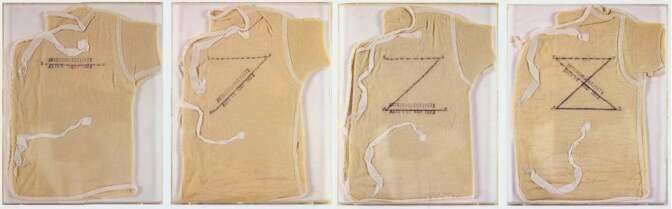
When this serial was commencement exhibited at the Found of Gimmicky Art in London in 1976, it was a sensation for all the wrong reasons: the dirty diaper liners that Kelly framed equally part of her documentation of her son's beginning years sparked the usual "is this fine art or rubbish?" controversy. Increasingly the series has been appreciated every bit radical in other ways: one of the most rigorous and systematic attempts to create a psychoanalytic matrix for analyzing the daily events and developmental milestones of a immature mother's life: her son's early sentences, scribbles and, yes, diaper liners meticulously recorded and framed. Kelly recently said the biggest misperception is that the work is a faithful recording of her son's fist years similar some sort of conceptual-art emblem volume. It's more, she said, almost the mother's experience and fifty-fifty separation anxiety as her son gains independence in the world.
Celeida Tostes'southward Passagem (Passage), 1979

First the Brazilian artist Celeida Tostes embedded pocket-size, noisy objects inside clay eggs or spheres that looked similar wombs. So, for an epic work in 1979, she placed herself inside ane: smearing herself with liquid dirt then climbing into what art historian Maria Angélica Melendi has described in the catalogue for "Radical Women: Latin American Art, 1960-85" as "an enormous vat of unbaked dirt suggestive of both an indigenous funeral urn and a womb." She had assistants seal her inside the vessel before she emerged, reborn, from it. The photographs documenting the performance, a highlight of "Radical Women," are moving: They certificate a adult female struggling to conjure upwardly an absent mother, an private losing herself in the undifferentiated muck of pre-life (in a related poem, she wonders if she is mineral, animal or vegetable), and an artist symbolically giving nascence to herself.
Judy Chicago's Birth Projection, 1980-85

1 of Chicago'due south nearly of import and least appreciated projects, this series consists of dozens of tapestries and mixed-medium works featuring birthing imagery made in collaboration with some 150 needleworkers. Not a female parent herself, Chicago asked others for accounts and also witnessed friends giving birth to capture what she has described equally "the glory and horror of the birth feel itself, the joy and pain of pregnancy, the sense of entrapment that goes along with the satisfactions of giving life." While the choice of medium conspicuously comes from the domestic realm, the highly stylized (and ofttimes boldly, some would say garishly, colored) images of female legs spread for a non-sexual reason gives the piece of work its punch.
Senga Nengudi's R.S.V.P., 1975-present

I have to acknowledge I probably saw three or iv different versions of R.S.5.P., the performance-activated sculpture that Nengudi made by filling pantyhose with sand and stretching information technology beyond corners or rooms, earlier thinking almost the improbable elasticity of the pregnant torso. But that is exactly how Nengudi herself described the piece of work, large enough to contain multitudes, to a Chicago Tribune reporter concluding year. "I'd just had my 2 children and was fascinated with this upshot of pregnancy, how you expand beyond all recognition sometimes," Nengudi said. "And so your body is and so resilient and just bounces back into shape — well, pretty much so. In that location was too the elasticity of the psyche during pregnancy, this abiding resilience that the body enacts."
Acme Image: Judy Chicago, The Creation from the Birth Projection, 1984, Modified Aubusson tapestry 42 x 163 inches. Executed by Audrey Cowan Drove of the Museum of Arts and Blueprint, NY; gift of the Robert and Audrey Cowan Family Trust
Source: https://www.kcet.org/shows/artbound/the-10-most-powerful-artworks-on-motherhood-from-the-20th-century
0 Response to "Art Piece Child Climbing Woman With Skeleton Behind Her"
Post a Comment