How to Upload Derivative Works on Wikimedia Commons
2016 update [edit]
As of March 2016, over 8.6 meg files have been uploaded with UploadWizard; this represents over a quarter of all files ever uploaded to Wikimedia Commons. This notably includes many pictures uploaded equally role of massive international contests similar Wiki Loves Monuments.
Introduction [edit]
Free works & Wikimedia websites [edit]
Wikipedia, the "complimentary encyclopedia that anyone can edit", is supported by the Wikimedia Foundation, a San Francisco-based nonprofit dedicated to empowering "every single man" to "freely share in the sum of all cognition". Although the English Wikipedia is the most famous website hosted by the Wikimedia Foundation, it is only one of more than 700 wikis.
They all share some common characteristics: outset, almost all of their content is in the public domain or under a "free license", which means the writer explicitly decided to share their work and allow anyone to use it for whatsoever purpose, even for commercial utilize. On a case-by-case basis, some wikis take besides chosen to host express unfree content that falls nether "Exemption Doctrine Policies" (EDP) such as "off-white use", in accord with the official Licensing Policy of the Wikimedia Foundation[1].
All their content is entirely created, improved and curated by volunteer participants. All these wikis are also based on the same wiki platform chosen "MediaWiki", a gratis and open source software written in PHP and mainly maintained by volunteer developers.
Wikimedia Commons [edit]
Wikimedia Commons is the key media repository for the more than 700 wikis supported by the Wikimedia Foundation, including Wikipedia. It was created in 2004 and now contains over 7 one thousand thousand media files, i.e. about twice equally much as the total number of manufactures on the English Wikipedia, created in 2001. All content on Wikimedia Commons has either been explicitly released under a complimentary license by the copyright holder, or fallen into the public domain; there is no "fair use" on Commons. Any media file uploaded to Wikimedia Commons can so be embedded into any Wikipedia article in any language, or whatever other Wikimedia website. It is even possible, for contempo websites using MediaWiki outside Wikimedia, to embed media files from Commons transparently.
As a Wikimedia website, Eatables is a collaborative platform based on MediaWiki, which provides an interface localized in more than 300 languages. Then, information technology serves an educational purpose; it is not a social networking website where users share their personal pictures with their friends. Also, Commons contains only freely reusable works; copyright violations and content with an unknown copyright status are speedily and proactively deleted. In this regard, Wikimedia Commons is different from popular media sharing platforms such as Flickr or Facebook.
However, even amid Wikimedia websites, Eatables has some characteristics of its own that brand information technology unique. Kickoff, it is a multimedia drove, whereas all other Wikimedia websites are primarily based on textual content. And so, it is a multilingual primal media repository for more than 700 other wikis. This has implications in terms of communications between participants, who have different cultural backgrounds and come to discuss in languages they are not necessarily proficient in. The other consequence is that Commons is ofttimes seen by participants simply every bit a manner to add a media file to another Wikimedia website, such as Wikipedia.
Over the years, uploading a media file to Wikipedia or Wikimedia Commons has grown increasingly difficult. Users are presented with a verbose and complicated upload form, every bit a consequence of both implementation-driven design and limited capabilities of the software, which was developed for textual content. Several attempts were made over the years to brand the upload process easier without changing the software. However, these changes could not replace dedicated improvements of the software to address the specific challenges of Wikimedia Eatables.
In July 2009, the Ford Foundation awarded a $300,000 grant to the Wikimedia Foundation to facilitate multimedia participation on Wikimedia websites, especially Wikimedia Commons, for people around the globe. The subsequent "Multimedia Usability Project" heavily relied on User research to better empathise the goals and needs of participants, and to build on MediaWiki to amend the User experience when contributing multimedia content.
Project summary [edit]
Projection scope and chief accomplishments [edit]
The grant proposal[2] referenced two principal deliverables:
- "Integrated upload tool: Through a pop-up tool, users will be enabled to upload media directly from the editing interface. This upload tool will intelligently distinguish between Wikimedia Eatables and a local project, depending on the licensing condition of the file being uploaded. The user interface will be minimal, and more advanced options will be attainable for use cases that deviate from default assumptions."
- "Help folio / tutorial organisation. A key trouble with the current uploading process is that instructions, warnings and explanations for many fringe cases accept been mixed with the actual uploading interface. We will develop a context-aware help system that can optionally exist accessed to explain difficult concepts such as off-white utilize, free content licensing, and so forth. This help organization may even include an interactive quiz that could potentially exist used as a precondition for participation."
Ii chief products were developed as part of this project, that reverberate these ii main deliverables: the Upload Sorcerer and the Licensing tutorial.
Upload magician [edit]
The upload sorcerer is a step-by-stride wizard allowing users to upload multiple media files to Wikimedia Commons. Its design was based on heavy user research, in order to improve the uploading feel for new, occasional and experienced users. It focuses on the most common cases, while withal allowing experienced users to customize their interface with shortcuts. Similarly, the process was streamlined to focus on the well-nigh important pieces of information, while allowing experienced or curious users to provide additional information if they wish then. The upload sorcerer besides contains a new congenital-in, context-enlightened assist system to provide admission to relevant information without overwhelming the user.
The upload wizard is not all the same attainable from the edit window, just it was congenital in a way that would facilitate its future integration in the editing workflow on projects like Wikipedia, as opposed to requiring users to visit a dissever website. The current separation actually makes sense while the projects maintain split infrastructure for purposes such as user-to-user messaging and alter notification. Until we have improved integration of this infrastructure, it would be too risky to but transparently send uploads to Wikimedia Commons, as users would not see these notifications, and the normal interaction with uploaders on Wikimedia Commons could break downwards. For the same reasons, it is non notwithstanding possible to implement an intelligent organisation that automatically directs media files to unlike wikis depending on the files' copyright status.
Licensing tutorial [edit]
The 2d main product created as part of this project is the Licensing tutorial. It complements the built-in help system of the upload sorcerer. The licensing tutorial is an educational i-page comic strip presented to users who upload a media file for the showtime time. Information technology explains the basics of copyright and gratuitous licenses, to avert mistakes from new users who are non familiar with free licenses. The format of a comic strip was chosen in order to be more enticing than a "wall of text" that has been proven to put users off.
In the beta version of the upload wizard, the tutorial is always shown. Information technology volition ultimately be less obtrusive and its integration will exist refined to be both more subtle and more accessible.
Project resources [edit]
Cadre team [edit]
Chronologically:
- Naoko Komura as Programme Manager. Originally hired equally Project Manager for the Wikipedia Usability Initiative[3], the scope of Naoko Komura'due south responsibilities was expanded to include the Multimedia usability projection. In March 2010, she was promoted to the position of Head of User Feel programs [4] only decided to leave the Wikimedia Foundation in June 2010[5].
- Guillaume Paumier was hired in October 2009 every bit Product Director and Interaction Designer[six]. Guillaume was responsible for user research, product requirements, design and communications.
- Neil Kandalgaonkar was hired in December 2009 equally Software Programmer[vii]. Neil was responsible for all software evolution, integration and deployment activities.
- Alolita Sharma was hired in July 2010 as Features Engineering Programs Manager. Alolita took over the Project oversight in July 2010 after Naoko Komura left.
Extended team [edit]
Chronologically:
- Christopher Nash and Kelly Goto, from gotomedia, conducted the June 2010 User feel study.
- Artist Michael Bartalos created the Licensing tutorial. Jay Walsh, Head of Communications for the Wikimedia Foundation, and David Peters, Design director for exbrook, were as well involved in the Licensing tutorial projection in an advisory capacity.
Project spending [edit]
See folio 20 of the grant proposal for the planned budget.
User enquiry [edit]
Enquiry program [edit]
A common arroyo would accept been to comport a User experience (UX) study from the outset and work from there. Withal, a preliminary analysis showed that much material was already available to place critical issues with the current upload process and workflow: the large community of users is commonly happy to provide information and feedback on a continuous basis. Too, our resource express the number of UX studies nosotros were able to carry during the project. As a effect, nosotros chose to focus beginning on an extensive preliminary research, combining both qualitative and quantitative information. We chose to wait until we had a first prototype earlier conducting a formal UX study. Our enquiry plan therefore consisted of three phases:
- Commencement, a preliminary user enquiry phase in the early stages of the project (Oct-December 2009), consisting of an inventory of the existing documentation, an online user survey, an open forum, ethnographic interviews (equally described by Cooper et al. [8]) and discussions with users, stakeholders & subject matter experts. The major goals of this phase were to observe and understand why and how users used the product, to identify or confirm critical issues that they encountered during their use and to collect input from various knowledgeable references.
- So, a formal UX & usability report vi months afterwards the beginning of the projection (March 2010), consisting of a "classic" study conducted with UX specialists. Participants would be presented with two interfaces: the initial interface as information technology was before any comeback, and a prototype adult using the preliminary research phase. The chief goals of this phase were to formally record the original user experience, to validate the bug identified by the preliminary written report, to uncover new problems and to validate the first blueprint decisions.
- Last, a final validation study at the finish of the project (Oct 2010), to formally assess the progress made and to identify remaining or new problems.
The final validation study was scheduled for November 2010, i.e. at the stop of the project. Nevertheless, it appeared that the visible features of he upload magician wouldn't exist very different from the version tested during the previous written report in June. Testing a actually similar interface once again would have been a waste material of resources, since it wouldn't have provided usa with much additional information compared to the previous written report.Equally a consequence, we decided to postpone the validation report until the end of the next stage of development.
Online user survey [edit]
- This section is a summary of the survey results; only the results with an impact on the design decisions are presented. For more details, see the full results.
The results of the online user survey showed a lack of awareness about Eatables, even among Wikimedia participants. We besides identified several types of users according to behavioral patterns, goals and habits, such as "Wikipedians", "Commoners" and "Gleaners".
Method [edit]
The main goal of the survey was to become a amend understanding of why the respondents used Wikimedia Commons (or why they did not), what activities they engaged in and why. An underlying goal was to meet how users reflected upon their own use of Wikimedia Eatables, and to compare this subjective cocky-reflection to objective data. Terminal, nosotros wanted to identify behavioral patterns based on correlations between goals, activities and levels of activity.
The survey ran during three days and was linked from all Wikimedia websites for all logged-in users. It was available in xx languages in order to address the multilingual nature of Wikimedia websites and specially Commons. During this time, 25,150 complete responses to the questionnaire were recorded. We used Pearson's χ² tests to evaluate the independence or correlation of some factors, using a threshold of 0.01%.
Users [edit]

Reasons for looking upwards files in Commons (or not).
First, we asked the users if they used Wikimedia Commons, and for what purpose; if they used it infrequently or not at all, we asked why non. Almost ii/3 (62%) of the respondents declared they used Commons (users), while the others declared they did not (not-users). More half the users identified their main goal when searching files on Commons as to illustrate an commodity on Wikipedia or another Wikimedia project; the second goal was to use media files offline. We also investigated the reasons why some respondents did not employ Eatables; given that the target audience of the survey was logged-in Wikimedia users, nosotros expected them to be aware of Commons, even if they did not participate in it. On the contrary, it appeared that 70% of the respondents who did not employ Eatables just did not know about it until the survey. Other reasons included problems due to the search feature or the predominance of English as the lingua franca.
Motivations to participate [edit]

Master goals of participants.
The users were then asked if they also participated in the activities of Wikimedia Commons. More than one-half the users (60% of users, 37% of respondents) alleged they did. Baytiyeh & Pfaffman recently studied the motivations of "administrators" volunteering their fourth dimension on Wikipedia[9]. They found that the master reason was a desire to larn and "an altruistic desire to create a resource for others to use". Our survey was broader and was not intended to exist equally thorough every bit Baytiyeh's. Yet, the key divergence betwixt Wikipedia and Wikimedia Eatables raised this question: were the motivations shared universally amongst Wikimedia projects? We asked the participants to place the main reason why they participated in Wikimedia Commons. 65% of respondents declared their main motivation was to illustrate Wikipedia or another Wikimedia projects. The donating desire to share with the world was consciously identified as master reason to contribute by only 11% of respondents; this proportion reaches 28% when consolidated with similar, but less explicit answers. Overall, contributing to Wikimedia Commons is widely considered by participants as a means to illustrate Wikipedia (or other Wikimedia projects), rather than a goal in itself.
Activities & levels of participation [edit]

Distribution of respondents by amount of files uploaded to Eatables.
We asked the participants how many files they had uploaded to Wikimedia Commons, how many edits they had made there and the frequency at which they performed certain tasks. Nosotros were surprised to notice that half the participants alleged they had uploaded less than ten files to Eatables: this means that many Wikimedia participants upload very few media files to Commons, or even none at all. Another third occasional participants uploaded between x and 100 files.
Own works [edit]
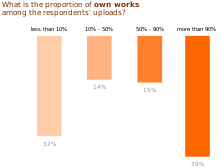
Proportion of own works amidst the respondents' uploads.
From a workflow signal of view, it makes a significant difference whether users are uploading works they created themselves ("ain works") or works created past other people (either relatives or strangers). If they created the piece of work themselves and they want to share it on a Wikimedia website, they only have to choose a free license compatible with the Wikimedia licensing policy. Uploading someone else'south work requires a completely different workflow, involving the possibility to check with third-political party copyright holders that they actually gave permission to use their work under the specified free license.
In order to proceeds a better agreement of these two cases, we asked the users to evaluate the proportion of own works amidst the total number of files they had uploaded. Based on preliminary analysis, we originally defined 4 slices: less than x%, from 10% to 50%, from fifty% to 90% and more than ninety% own works*. It appeared the answers were generally very similar for users in the 2 central groups (betwixt x% and 90%). The ii extreme groups, however, are most significant; 39% of the participants declared they had uploaded more than than 90% of own works, thus constituting a group of "Creators" (photographers, illustrators, mapmakers, etc.). 32% of the participants uploaded less than ten% of own works.
A correlation can be established betwixt the ratio of own works and the frequency of uploads. Participants who uploaded less than x% of own works are as well the ones who rarely upload media files at all. Similarly, there is a correlation between participants who uploaded between ten and 90% of own works and those who upload new files on an occasional or a regular basis. Last, participants who uploaded more than 90% of own works are correlated to the participants who upload new files very oft.
What this ways in terms of design is that the interface should be optimized for the nearly common case, i.east. for people who share their own works, while all the same allowing some flexibility for the other users.
Multimedia developers and users workshop [edit]
In Nov 2009, Wikimedia France and the Wikimedia Foundation organized a multimedia-focused workshop in Paris, France. One of the key objectives of the meeting was to help inform the Multimedia Usability Project team to better the usability of Wikimedia Commons.
During the meeting, proficient users and developers worked together to share understanding, produce documentation and develop or deploy new multimedia tools. The main accomplishments of the workshop included:
- an increased awareness of our shared activities through demonstrations and discussions
- the experimental roll-out of a feature to track usage of media from Wikimedia Eatables beyond other Wikimedia projects; a first implementation of wiki-editable subtitles for videos, and smaller hacks and improvements.
- draft ideas and concepts for improving the user experience on Wikimedia Commons as a whole
- a clearer articulation of the needs that are specific to working with cultural institutions (galleries, libraries, archives, and museums – "GLAM")
Open forum [edit]
At the end of the survey, respondents were offered the possibility to leave free comments on a dedicated page on Wikimedia Commons. The folio, called Commons:Usability issues and ideas, was likewise advertised in other places. The goal was to provide a central and persistent page where users could written report issues in a familiar setting, rather than on an unintuitive problems tracker. The page was as well used to collect feedback on the Upload magician once the prototype was released. The problems were then summarized and consolidated on another folio.
Analysis of bugs and feature requests [edit]
Nosotros analyzed several hundreds bugs and feature requests related to Multimedia already registered in MediaWiki's and Wikimedia's bug tracker. A much needed cleanup was done; the remaining items were listed on the usability wiki and organized in nine categories, depending on what they affected: Uploading, Maintenance, Editing, Using and reusing content, Crosswiki integration, Multilingual back up, Navigation, Metadata and Dorsum-finish. They helped us identify the areas that needed improvement, and guided blueprint decisions.
Ethnographic interviews [edit]
"Ethnographic interviews" (as described past Cooper et al. [eight]) consisted of field observations and contextual inquiries performed in the user'southward usual environment, in order to cause petty disruption and to observe the user as they usually interact with Eatables and the upload process. The original goal was to perform a number of interviews, model user personae and use them to blueprint the products. However, due to time and fiscal constraints, information technology was not possible to fully follow this method. Instead, nosotros had to create provisional personae, with the hope to revisit them afterward.
Four users were interviewed, with dissimilar background activities. Notes of the sessions were posted publicly on the usability wiki.
Upload wizard [edit]
Design [edit]

Set of wireframes describing the upload magician

Workflow view of the upload wizard
The upload wizard was designed based on this extensive preliminary research stage. Information technology aims to replace the default upload class nowadays in MediaWiki.
Our inquiry highlighted the post-obit issues:
- In an attempt to prevent all mistakes, long walls of text were presented to the user, mixing:
- rules about what was immune or not;
- detailed instructions on how to fill the class;
- education on & advocacy for free licenses;
- diverse pieces of advice and recommendations.
- Everything was on one long folio.
- The layout didn't emphasize important fields (like "License") over seldom-used or optional ones (like edit tools, or "additional data")
- It displayed wikitext.
In contrast, the design of the upload magician was guided past the post-obit principles and decisions:
- Using a wizard format, with several steps, to emphasize specific moments and let the user focus on them;
- Decoupling the educational part about costless licenses from the actual upload course, by presenting a separate licensing tutorial;
- Encouraging the user to naturally practice the correct thing, instead of providing pages of instructions of what they must and must not do;
- Facilitating the most mutual workflows, while yet allowing uncommon cases for experienced users (this includes providing sensible defaults and hiding uncommon fields)
- Using plain English language linguistic communication instead of jargon or legal terms, while still being specific;
- Request as little data as possible (and required), and suggesting as much as possible (this includes extracting relevant information from the file's metadata).
Considering of our limited grant period, we had to prioritize features included in the upload sorcerer. We optimized for the most common cases, in order to benefit as many users equally possible, based on our inquiry.
Software architecture [edit]

UploadWizard's multiple-file upload timeline diagram
- For more technical details, see the UploadWizard's technical documentation on mediawiki.org
The Upload wizard relies on the aforementioned architecture already in use in MediaWiki and on Wikimedia Eatables. Still, it adds several other features and layers:
- It handles the simultaneous upload of multiple files.
- It provides a wizard-style interface
- It uses a "stash" system, a new way of storing data and media files that stops just short of publishing them to the Wiki.
The terminal item is peculiarly important more often than not due to a quirk of how web browsers have traditionally worked. Web browsers tin can't clarify the files they are uploading or provide any information virtually them, non even a thumbnail -- they need help. Equally a consequence, the Upload wizard first uploads the files to the server, and then gets:
- Thumbnails for each image (helpful for identifying multiple files)
- An assay of the metadata in each file. For instance, many photos take data hidden within them that tells us when they were taken. We can use that information to prefill many class fields. (The user tin nonetheless change them).
The user tin complete filling out all this data in relative peace, focusing on ane thing at a fourth dimension, not worrying if they've accidentally released an unlicensed file into the public sphere. And and then when they're ready, they tin publish it to the wiki.
Paradigm [edit]
A prototype wiki was gear up to provide a testing environs that would reverberate the latest land of the upload magician. The epitome's configuration was similar to that of Wikimedia Commons, simply only contained a small subset of its content. Due to various compatibility issues, the prototype wasn't updated as oftentimes as desired. Nonetheless, it allowed volunteer testers to provide effective feedback and to see the prototype evolve and improve over fourth dimension.
UploadWizard 0.1 [edit]

Screenshot of the simultaneous upload of files with the UploadWizard
A beta version of the UploadWizard was launched on Wikimedia Commons on November xxx, 2010[10] A discrete link to information technology was added to the "own work" upload workflow on Eatables. Files uploaded with the upload magician are placed in a defended tracking category.
A detailed analysis of the tool'due south success was not possible in the time allocated, as expected in the grant proposal. Further inquiry will need to exist conducted to formally assess using qualitative and quantitative metrics.
Localization and dissemination [edit]
The upload wizard was developed as an extension for MediaWiki and released under the GPL. While it was primarily targeted at Wikimedia Eatables, and though it is yet beta software, it tin can be reused by whatsoever (ane.sixteen and to a higher place) MediaWiki-based website that wishes to provide its users with a ameliorate uploading experience. Information technology was built in such a way that information technology can be customized depending on each wiki'south rules, particularly regarding copyright.
As a MediaWiki extension, the upload wizard was made available for translation by volunteer translators on http://translatewiki.net. As of October 15, 2010, volunteers from 63 languages had participated in the translation process. The software interface was fully, or almost fully (> ninety%), translated into 25 languages, including French, Indonesian, Chinese, Polish, Russian and Japanese.
Licensing tutorial [edit]
The licensing tutorial was the second master deliverable of the Multimedia usability project. Its main audition was new users who were uploading their first media file to Wikipedia or Wikimedia Commons.
Almost of them are not familiar with free licenses and have never been educated virtually copyright. The tutorial would be shown by default to any new user when they first upload a file, regardless of their linguistic communication, culture or country of origin.
Objectives [edit]
Learning goals [edit]
The tutorial would be considered a success if the user completed information technology and:
- had a basic understanding of what copyright is
- had a basic agreement of what information technology means to release a file under a complimentary license
- understood that any cloth is considered to be unfree unless explicitly said otherwise
- was able to determine, for simple cases, to which of the two big families (unfree or free) a media file belongs. Examples of "simple cases" include: a CD comprehend, a picture taken by the user, a pic from a film and a random picture found on the Net.
Requirements [edit]
Nosotros defined the post-obit requirements for the tutorial:
- Brusk: the basic tutorial is not a goal per se, simply a necessary pace for new users who want to upload a film. Going through the tutorial shouldn't last more than a minute, max. 2.
- Easily translatable: Wikimedia websites target an international audience, and Wikimedia Commons in particular is multilingual, as the cardinal media repository for all other Wikimedia websites.
- From an international, cross-cultural standpoint: our audience is potentially anyone on the planet who has admission to Internet, so we couldn't use cultural references that could be offensive or misunderstood by a specific subset of our audience.
- Fun, enticing, not likewise deadening: we wanted users to actually read and complete the tutorial.
- Lightweight: our audience is very broad and we wanted anybody to be able to watch the tutorial, regardless of their bandwidth.
Format [edit]

Example of a comic strip created by a volunteer to advocate for dual licensing.
In that location had been several attempts in the past to create comic-like tutorials to explain basic topics near copyright and costless licenses (see Supporting data), only their format made it especially difficult to watch online and translate. An animated or even so comic-like format (that would be displayed in an overlay or inline) was the best way to meet our requirements. Wikimedians normally adopt vector graphics to let for resizing, localization and general editing; the preferred format for MediaWiki is SVG. Since animated SVGs were still in a paradigm state, and not nevertheless supported by MediaWiki, we decided to commission a set of still SVGs.
We also decided to avert spoken communication bubbles since they would make localization more than difficult (peculiarly for "verbose" languages).
The final deliverables were to be released nether the Creative Commons - Attribution - Share Alike license.
Chronology [edit]
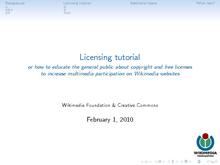
Supporting slides for the discussion with Creative Eatables
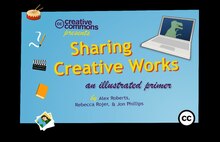
Sharing creative works: a comic strip by and about Creative Commons
In February 2010, we invited Mike Linksvayer, Lila Bailey and Alex Roberts, from Artistic Commons, to discuss the licensing tutorial. Educating the public near free licenses is a goal Artistic Eatables and the Wikimedia Foundation share. Artistic Commons shared their feel in creating visual documents to explicate free licenses, and offered to provide feedback on our tutorial.
Over the side by side few months, we discussed the project and the kind of person we needed for it with Jay Walsh, Head of Communications for the Wikimedia Foundation, and we created a creative cursory.
Given our timeline, we decided to await for a local artist, rather than to send a global call for proposals. Jay Walsh reached out to his network, keeping in mind 2 major criteria: our express budget, and our peculiar weather (such as releasing the work under a free license).
Nosotros reviewed the piece of work of several possible artists and narrowed down the list, with the help of David Peters, a local design director with whom the Wikimedia Foundation has been working on several blueprint projects.
In Baronial 2010, as a outcome of this preliminary work, nosotros reached out to Michael Bartalos, an illustrator from San Francisco. Michael had previously done some interesting work for the California Academy of Sciences; his way was specially close to what nosotros expected for the tutorial. Moreover, he was ane of the only artists already familiar (and comfortable with) free licenses.
After a few email discussions, we met in September 2010 to discuss the chief topics that needed to be addressed past the tutorial; Michael Bartalos presented draft sketches. Following this discussion, nosotros decided to move forrad with this partnership.
Over October and November 2010, we went through a few cycles of creation, feedback, and corrections. A panel of experienced Wikimedians reviewed the successive iterations of the artwork and provided constructive and high-quality feedback, beginning on the general approach and content, then on specific details of wording and graphics.
Consolidated summaries and then helped the illustrator work on the next version without having to deal with long discussions and contradictory statements[11].
Final product [edit]

Concluding tutorial in English
The "final" tutorial in English was officially published on Nov 5, 2010[12] Information technology was only "concluding" from a project point of view. Indeed, the Wikimedia community quickly appropriated the tutorial and improved it farther, particularly to optimize its size and rendering online.
Translation, localization and dissemination [edit]
Once the English language version was published, the translation and localization process began. A call was fabricated to volunteer Wikimedia translators to help translate the tutorial in as many languages as possible[13]. A item interest was given to languages whose Wikipedia has disabled file uploading locally, since they were more likely to upload files to Wikimedia Commons.
A translation and localization hub was created on meta-wiki for the licensing tutorial, containing recommendations and instructions to help volunteers. The tutorial rapidly garnered interest from translators[14], who also appreciated the exhaustive information on the translation hub.
The translation of the content and localization of the graphics were handled separately, in club to more easily distribute the work depending on each volunteer'due south strengths.
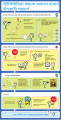
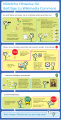
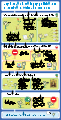
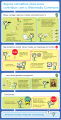
As of January 2011, the text of the tutorial had been completely translated into 24 languages, and integrated into dedicated versions of the graphics (see below). Languages include Standard arabic, Bengali, German language, Greek, Macedonian, Malayalam and Vietnamese.
Private graphical pieces of the tutorial were uploaded to Wikimedia Eatables in lodge to facilitate reuse. Some of them have already been remixed. Puzzly, the character from the tutorial, was besides given a social presence on twitter, identi.ca and facebook.
-
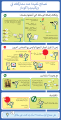
Arabic
-

Bulgarian
-
Bengali
-

Catalan
-

Czech
-

Danish
-
German
-

Greek
-

Spanish
-

Finnish
-

French
-

Hebrew
-

Italian
-

Japanese
-

Korean
-

Macedonian
-

Malayalam
-

Norwegian
-
Shine
-
Portuguese
-

Romanaian
-
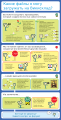
Russian
-

Vietnamese
-

Swedish
Measures of success [edit]

The grant proposal defined "the fundamental measure of success" every bit "the ability of users in tests before and subsequently the completion of the project to perform the given tasks": "If the failure charge per unit of users in performing the given tasks is significantly reduced, the project tin can be considered a success." In order to measure out this ability, we partnered with an contained UX and Usability research firm.
We reached out to some UX firms and published a Call for proposals in February. Several firms submitted proposals; after serious consideration, we chose to piece of work with gotomedia, a San Francisco-based firm that seemed to align best with our goals and values.
The study was planned to take place in March, simply was postponed because the prototype was not ready. In the meantime, we asked some of our co-workers to test it in society to uncover the near obvious flaws & bugs.
The actual testing eventually took place in June 2010. Eleven users participated in the exam: five locally in San Francisco, and vi remotely within the US. Nosotros considered conducting similar testing abroad, in order to identify language-specific problems; but in the stop, it turned out that we wouldn't larn a lot by merely replicating the same test script. Multilingualism on Commons (and Wikimedia websites generally) is a huge piece of work that deserves dedicated efforts, and dedicated UX studies.
Results [edit]
Three highlight videos were produced out of this report: ane near the testing of the current interface on Eatables, one near the testing of the paradigm, and the final one about how the prototype could still be improved. Highlight videos are edited summaries of the main findings of the study.
I of the primary remaining issues was the fact that users don't really sympathize copyright and free licenses. Our Licensing tutorial was not yet available at the time of testing, but we believe information technology volition assist accost this issue.
The content of these sections comes from the study study provided by independent usability firm gotomedia. The full study written report is also bachelor in PDF format.
Findings: Current Wikimedia Commons Upload Interface [edit]
Current interface testing video
In order to establish a baseline for usability, and to certificate the current interface, five participants were asked to use the current Wikimedia Commons Upload Interface to upload an image. For in-person participants, an image file was provided for the participant to upload. Remote participants were asked to upload any paradigm file from their ain computer.
- Participants rated the interface a iii.8 for "ease of utilize" on a scale of 1 to x. All participants gave the interface relatively poor marks for "ease of employ." On a scale of 1 to ten, ratings ranged from ii.five to five, with an boilerplate score of iii.eight.
-
- "I'd give information technology a 5. It wasn't necessarily difficult, simply there were parts of it that left me a little lost." -Carmen, 25, Student.
- Besides much text. All participants who saw the current interface used phrases such equally "likewise much text," "text-heavy," and "pages of text" to depict the interface. The current interface for uploading original work presents detailed instructions and guidelines for uploading files at the top of the page, and the full uploading class at the bottom of the page, beneath the fold. At first glance, none of the form fields are visible, and the page truly is all text. This proved to be intimidating to users, many of whom said that they would take been unlikely to go on with the upload were they not participating in the report.
-
- "It was a real turnoff to engage in uploading a file and the first thing they sent me to was a page that was really text heavy with warnings. The message really is 'You lot might not know what you're doing and then y'all better not upload it.'" –Elina, 28, Graphic Designer
- The presence of wikitext, without articulate instructions, intimidated users. All of the participants who tested the electric current interface had limited or no experience with editing Wikipedia. These users were understandably intimidated past the wikitext that they encountered in the upload form, and the assistance content that was provided effectively dislocated users even more than. [...]
-
- "Authors, tags and syntax, some people would be turned off past all this. At my level of knowledge I wouldn't really know how to edit this part. There's a real learning curve to upload it properly." – Alexandra, 54, Treasure Hunt Designer
Findings: Wikimedia Commons Image Upload Interface [edit]
Image highlight video
All participants were asked to utilise the prototype interface to upload an image every bit if it were their own piece of work. For in-person interviews, users were provided with a choice of images of the Gilded Gate Bridge on the testing car. For remote interviews, participants were asked to use whatever image file from their own computer.
All participants were then asked to upload a 'institute' image from the spider web. For this task, participants were referred to a photo weblog folio that was created for this exam. The blog page included a photo of the Gilded Gate Bridge, with the author and licensing information clearly displayed on the folio.
- All participants who saw the electric current interface vastly preferred the prototype. From the moment that the upload wizard loaded, users were immediately more comfortable with the image than they had been with the current Commons upload interface. Some participants who did not go through the current interface during testing had some previous feel with the current upload process. These users too preferred the prototype to their memory of the interface they had used in the past.
-
- "I tin can already see that there's a lot put in place to be a lot more than encouraging and guiding for the user." – Elina,28, Graphic Designer, on page load of the upload wizard.
- Participants rated the interface an 8.9 for "ease of utilize" on a scale of ane to 10. All participants gave the interface high marks for "ease of use." On a scale of 1 to 10, ratings ranged from vii to 10, with an average score of 8.9.
-
- "Oh, this was groovy. This was a x, hands. I'm actually very happy through this procedure. It brings me a trivial flake of joy, and makes me want to upload more than files." – Jichen, 27, Videographer
- "A 10! It was easier than I call back any sort of file upload I've always used. Very straightforward." - Cassie, 29, Student
- The offset step of the upload wizard was well received by all participants. Participants really liked the visual representation of the upcoming 4-step process. None experienced whatsoever difficulty at this step.
-
- "It's squeamish to have all the steps laid out for you, like explanations of how to exercise things that are visually clean." – Erin, 27, Environmental Planner.
- "First affair I'yard noticing, I'1000 seeing this bar. I like that because information technology tells me there are 4 things, there'southward a procedure and it tells me where I am in the process." – Candy, 49, Business Consultant
- The pre-selected default license was well received. All participants hands navigated the first portion of the Release Rights step, selecting "This file is my own work." Users appreciated that a license was recommended for them. Most indicated that they would exist inclined to utilize the recommended license. Some were more concerned with the specifics of the licenses than others, but all appreciated the guidance provided by the recommendation.
-
- "I've got a suggested license option, nice. That's expert." – Ian, 40, University Professor
Summary [edit]
Usability and Comprehension [edit]
All participants who saw both the current Wikimedia Commons upload interface and the Upload Wizard epitome vastly preferred the prototype, and with proficient reason. Users establish the current interface unnecessarily intimidating and cumbersome. 1 user went then far as to say the interface left him feeling "hurt and suspicious," and another noted that the copious warnings in the interface left her feeling like she'd better not upload annihilation because she may not know what she is doing.
In dissimilarity, the Upload Sorcerer prototype was very warmly received. Amongst those participants who had just used the current interface, an aural sigh of relief was often the outset response upon seeing the first pace of the prototype. All users understood what was expected of them during the upload process. All appreciated the clean uncluttered feeling of the layout, forth with the top progress bar that laid out the upcoming steps and marked their location within the larger process. The paradigm effectively removes wikitext from the upload process completely, which should be a goal for all Wikimedia Usability Initiative projects.
While participants used the image with relative ease, their comprehension of the licensing decisions they made during the upload was sub-optimal. Information technology should be noted that there was no meaning deviation in licensing comprehension between users who saw only the prototype and those who saw both the epitome and the current interface. In the electric current interface, users were inundated by besides much text, then they did not read very much of it. In the prototype, users merely were not provided with the information that they needed to empathise the licensing options. It would announced that comprehension for users who saw the current interface was no improve than for users who did not.
Room for improvement [edit]
Room for improvement highlight video
The Upload Sorcerer prototype represents an excellent start on a new interface for uploading images to Commons. Going forward, efforts should be concentrated in two areas: making the interface more robust and reliable, and providing better access to licensing information and decision-making tools.
At that place were a few features missing from the interface at the time of testing, and performance issues hindered users' experience as well. The progress bar did not display for most users during upload for example. Category pick was missing from the interface birthday. Now that a good solid infrastructure has been congenital for the interface, information technology is time to fill it out with a consummate feature set and shore up the code to eliminate bugs and operation issues.
On the messaging front, the interface needs to provide admission to more consummate information virtually licenses without falling into the same traps that hampered the UX in the current interface. Wikimedia needs to provide just enough information within the wizard, along with access to data exterior the wizard, to empower users to make informed licensing decisions, and without spoiling the clean uncluttered interface that our participants so clearly enjoyed. A change in the way uploads are described ('donations' instead of 'contributions') may also help user comprehension.
The Add together Media Wizard prototype besides represents a great improvement for Wikipedia and Wikimedia Commons. The wizard removes a lot of the direct manipulation of wikitext that is currently required in order to add together an image to an article. The wizard will too raise awareness of Commons and the vast resource available there. Many Wikipedia users are completely unaware of Wikimedia Commons. When implemented, the Add Media Wizard will brand contextually relevant content from Commons available to Wikipedia editors from within the editing interface. This should significantly better the synergy between the two projects. Going forward, the relatively minor changes outlined above will improve usability.
Files [edit]
The highlight videos are available on Wikimedia Commons; per our agreement with gotomedia, all the videos were released under the Artistic Commons Attribution - Share alike 3.0 license.
- Current interface testing: File page on Commons – Download OGV file (4m11s, 29.89 MB) – Scout on Vimeo.
- Prototype testing: File page on Commons – Download OGV file (5m32s, 35.43 MB) – Watch on Vimeo.
- Room for improvement: File page on Commons – Download OGV file (3m51s, 23.02 MB) – Picket on Vimeo.
- Concluding study written report: File:Multimedia UX written report June 2010 final written report.pdf – Download PDF file (35 p., 1.6 MB)
Long-term analysis [edit]
In the long term, nosotros expect to come across a relative increase of participation in Wikimedia Commons. Nosotros will be able to mensurate this increase by comparing the rate of uploads per day before and later on the deployment of the upload wizard. However, providing such measurements was not possible inside the grant period. Even so, files uploaded with the Upload wizard on Commons are tracked in a dedicated category.
Communications [edit]
During the entire project, an effort was made to be equally transparent and inclusive equally possible. This meant reaching out and listening to users and the Wikimedia customs, but also proactively and regularly communicating our progress to a diverseness of audiences.
Usability wiki [edit]
Almost all of the documentation was hosted on the usability wiki and linked from the Multimedia hub. The Multimedia usability project was the first grant-funded projection whose total grant proposal was published and publicly available.
The usability wiki was retired in January 2011, every bit both grant-funded projects that used it were over.
List of online communications [edit]
- Wikimedia Foundation receives Ford Foundation grant to abound Wikimedia Commons, a free educational media repository. Press release, Wikimedia Foundation, July 2009.
- Ford Foundation Awards $300K Grant for Wikimedia Commons. Erik Möller, Wikimedia Web log, July two, 2009.
- Multimedia Usability Projection Underway. Naoko Komura, Wikimedia Web log, Jan 26th, 2010.
- Améliorer l'ergonomie de Wikimedia Commons cascade encourager la participation. Delphine Ménard, Wikimedia France's blog, Nov 19, 2009.
- Beyond Text: Report from the Multimedia Usability Meeting in Paris. Erik Möller and Delphine Ménard, Wikimedia Weblog, December 1st, 2009.
- Help us collect good ideas to improve Wikimedia Commons. Guillaume Paumier's weblog, December 1, 2009
- IRC office hours, Feb iv, 2010
- Wikimedia Multimedia UX testing videos. Guillaume Paumier's web log, July 23, 2010.
- Multimedia upload sorcerer: preliminary exam results promising. Jarry1250, Wikipedia Signpost, July 26, 2010.
- Upload wizard: Questions & Answers, Multimedia usability team, Baronial 7, 2010.
- Prototype upload wizard unveiled for Wikimedia Commons. Guillaume Paumier, Wikimedia blog, Baronial 7, 2010.
- Multimedia Upload Magician fix for testing. Jarry1250, Wikipedia Signpost, August nine, 2010.
- One-click reuse buttons on Wikimedia Eatables. Guillaume Paumier's weblog, Oct 4, 2010.
- Illustrated licensing tutorial for Wikimedia Commons. Guillaume Paumier, Wikimedia weblog, November 5, 2010.
- Wikimedia Commons licensing tutorial: the making-of. Guillaume Paumier's web log, November 19, 2010.
- Wikimedia Eatables Licensing Tutorial. Michael Bartalos, Bartalos Illustration, November 26, 2010.
- New Upload Wizard launches in beta on Wikimedia Eatables. Guillaume Paumier, Wikimedia blog, Nov 30th, 2010.
- Commons Upload Magician. TheDJ, Wikipedia Signpost, Dec vi, 2010.
Conferences [edit]
KDE Akademy 2010 [edit]
Video of the KDE Akademy 2010 talk
Supporting slides for the KDE Akademy 2010 talk
In July 2010, Guillaume Paumier attended the KDE Akademy 2010 briefing in Tampere, Republic of finland. Along with Parul Vora, he gave a talk entitled Wikimedia User Experience programs: lowering the barriers of entry and presented the work washed as part of the Wikipedia usability initiative, and the Multimedia usability projection.
It might seem odd for Wikimedia to be presenting at KDE Akademy: Wikimedia is by and large most online content, while KDE is by and large virtually desktop software. Yet, they share common goals & values. On the one hand, a common criticism made against KDE is its complexity, a upshot of its loftier customizability. On the other manus, MediaWiki, the software on which rely Wikipedia and the other Wikimedia websites, suffers from the aforementioned flaws[15]: information technology has always been "designed" by developers. As a consequence, the interface reflects the implementation model, and often doesn't match, or fifty-fifty conflicts with, the user'southward mental model. The Wikimedia Foundation recently started to include user inquiry and blueprint every bit part of their development wheel, where user feel is taking a increasingly critical role. This presentation at Akademy was an opportunity to share feel. Both KDE and Wikimedia communities struggle to improve complex interfaces, and both communities have a lot to learn from each other.
Thanks to KDE due east.V. and their volunteers, the total video of the talk (and the follow-upward discussion) was made available from the Akademy schedule page under the Artistic Commons Attribution Share Alike license. A slightly edited version is also available from Wikimedia Commons, forth with the supporting slides.
Besides this presentation, Akademy was besides an opportunity to meet with the KDE customs and discuss collaboration opportunities, specially to work towards a better integration of Wikimedia websites with the desktop. Ideas related to multimedia content include a mass upload tool[xvi], a "Picture of the day" desktop widget, and an awarding plugin to find media files from Eatables from within an role application.
- Video: File folio on Eatables – Download OGV file (28m4s, 162 MB)
- Supporting slides: File folio on Commons – Download PDF file (2.12 MB)
WikiSym 2010 [edit]
Supporting slides for the WikiSym 2010 talk
On July 7-viii, Guillaume Paumier attended the "International Symposium on Wikis and Open Collaboration" (WikiSym 2010). For the first time, WikiSym was collocated with Wikimania in Gdańsk, Poland (see beneath). Information technology was a opportunity for researchers & Wikimedians (or "practitioners", as researchers phone call them) to get together and meet. The Wikimedia Foundation was then engaged in an effort to include research into their controlling procedure in order to go far more than data-driven. It was thus the perfect time to try and build sensation, agreement and relationships between the two communities.
Guillaume Paumier submitted a enquiry paper presenting the results of the user research fabricated for the Multimedia usability project, in particular the survey. The paper was accepted by the Programme Committee, just could eventually not be published due to copyright restrictions imposed past the proceedings publisher[17]. Nonetheless, he was able to requite a twenty-minute presentation of his work, entitled Understanding the users of Wikimedia Commons. The talk was well received and the audience particularly liked the videos from the UX study.
- Supporting slides: File folio on Eatables – Download PDF file (504 KB)
Wikimania 2010 [edit]
Supporting slides for the Wikimania 2010 talk
On July 9-eleven, post-obit the WikiSym briefing, Guillaume Paumier attended the Wikimania 2010 conference, the almanac customs conference of the Wikimedia motion.
Guillaume Paumier gave a 40-minute presentation of the project, entitle "Increasing Multimedia participation on Wikimedia websites". The talk included an overview of the user research, a demo of the current interface, an assessment of the challenges Commons faces, and a demo of the prototype. Videos from the UX study were also presented. The talk was well received and the audience expressed interest in the upload magician'south deployment to production[18].
The presentation was filmed, only the recordings haven't been fabricated available yet.
- Video: not available all the same.
- Supporting slides: File page on Eatables – Download PDF file (two.36 MB)
References [edit]
- ↑ Resolution:Licensing policy. Wikimedia Foundation, March 2007.
- ↑ Proposal: Ford Foundation Multimedia Participation Project. Erik Möller, Sara Crouse, Naoko Komura, February 27, 2009
- ↑ Now hiring for Wikipedia Usability Initiative. Brion Vibber. Wikimedia Foundation list, January 9th, 2009.
- ↑ Extending our user feel effort. Erik Möller. Wikimedia blog, March 2nd, 2010.
- ↑ Naoko Komura leaves Wikimedia. Erik Möller. Wikimedia announcements list, May 25, 2010.
- ↑ Guillaume Paumier joins the Ford multi-media usability project. Naoko Komura. Wikimedia Foundation list, October 17, 2009.
- ↑ Neil Kandalgaonkar as Software Developer for Ford Multimedia Usability Project. Naoko Komura. Wikimedia Foundation list, Jan 27, 2010.
- ↑ a b Well-nigh Face 3: The Essentials of Interaction Design. A. Cooper, R. Reimann, and D. Cronin. Wiley, Indianapolis, IN, third edition, 2007. (ISBN ane-56884-322-4)
- ↑ Why exist a Wikipedian. H. Baytiyeh and J. Pfaffman. In CSCL'09: Proceedings of the 9th international conference on Computer supported collaborative learning, pages 434-443. International Lodge of the Learning Sciences, 2009.
- ↑ New Upload Magician launches in beta on Wikimedia Commons. Guillaume Paumier, Wikimedia weblog, November 30th, 2010.
- ↑ Wikimedia Commons licensing tutorial: the making-of. Guillaume Paumier's web log, Nov 19, 2010.
- ↑ Illustrated licensing tutorial for Wikimedia Commons. Guillaume Paumier, Wikimedia blog, November 5, 2010.
- ↑ New request: Licensing tutorial for Wikimedia Eatables. Guillaume Paumier, Wikimedia translators mailing list ("translators-50"), November 5, 2010.
- ↑ New request: Licensing tutorial for Wikimedia Commons give-and-take thread . Wikimedia translators mailing list ("translators-fifty"), Nov 2010
- ↑ Wikimedia User experience programs: a systematic arroyo. Guillaume Paumier. March 4, 2010.
- ↑ digiKam / KDE imaging coding sprint 2009. Guillaume Paumier. Nov 17, 2009.
- ↑ WikiSym 2010. Guillaume Paumier's weblog, July 28, 2010.
- ↑ Wikimania 2010 notes. Guillaume Paumier's weblog, Nov 22, 2010.
Source: https://meta.wikimedia.org/wiki/Multimedia_usability_project_report
0 Response to "How to Upload Derivative Works on Wikimedia Commons"
Post a Comment